

Allow me to introduce you to one of the most fascinating episodes in Canadian history.
On September 13, 1759, one of the most decisive battles in the history of North America took place.
It is known as the Battle of the Plains of Abraham, or the Battle of Quebec, and it is largely thanks to its outcome that most of the French possessions in North America came under British rule.
The battle’s legacy proved to be long-lasting; Canada’s head of state, for example is still, to this day, the British monarch.
Table of Contents
The Battle of the Plains of Abraham

The Battle of the Plains of Abraham was part of the larger Seven Years’ War (or French and Indian War, as the North American theatre is sometimes known) that was taking place in Europe. The conflict between France and Britain, who were on opposite sides of the European war, spilled over into their colonies in North America.
At the start, Québec City was held by the French. The city is located at a strategic point on the St. Lawrence River: control here meant controlling access to the west.
The British, unsurprisingly, wanted that control.
After months of bombardment and skirmishes, and even a minor French victory near the Montmorency Falls, everything came to a head one night in September.
General James Wolfe, the British commander, planned a daring assault. Under the cover of darkness, he would send troops across the river and have them scale a 50m (164ft) cliff, surprising the French defenders just west of the city.
The plan worked. The open plain just to the west of the city was sparsely defended as the French commander, Louis de Montcalm, concentrated his troops north, the more tactically sound point for an invasion.
The British also has a stroke of good luck. The French were expecting supplies to arrive that day. But no one informed them that the supply run had been cancelled. The French then assumed the commotion by the river was caused by their fellow countrymen – not British soldiers.
Easily defeating the few French defenders, the British gained a solid foothold at the top of the hill. Their luck held: General Montcalm didn’t believe the initial report of the attack and took no action.
By the time Montcalm realized his mistake, the British were already in position. The French general decided to meet them in open battle, not the wisest move considering many of his troops were not regular soldiers trained to fight in 18th century battle formations, but militiamen and their native allies, whose strength lay more in guerilla tactics.
After a battle lasting about an hour, the fate of a continent was decided. The British soundly defeated the French, Quebec and later Montreal surrendered, and a few months later at the Treaty of Paris, France ceded their North American territories to Britain.
The Battle of the Plains of Abraham would claim the lives of over 150 men, including both commanders. Wolfe died on the battlefield, assured of his victory. Montcalm was wounded, returned into the city, and died the next morning, conscious of his defeat.
The Plains of Abraham today

Today the Plains of Abraham are a historic 240-acre park, administered by the National Battlefields Commission (which was created specifically for it).
Open all year round, the different seasons offer different experiences.
In summer, the park is a popular place to take a walk, jog, have a picnic, read a book, bring their dogs, or enjoy an outdoor concert.
In winter, the Plains of Abraham transforms into a winter wonderland. You can go cross-country skiing or snowshoeing along trails, or ice skating in the rink.
While being the site of one of Canada’s most famous battles is reason enough to visit, there are a few additional points of interest within the park itself.
Martello Towers

Four Martello Towers were built in the early 19th century by the British as part of Québec City’s defensive system. They were never used in battle.
Today, three remain and you can explore inside at least one of them.
Edwin Bélanger Bandstand
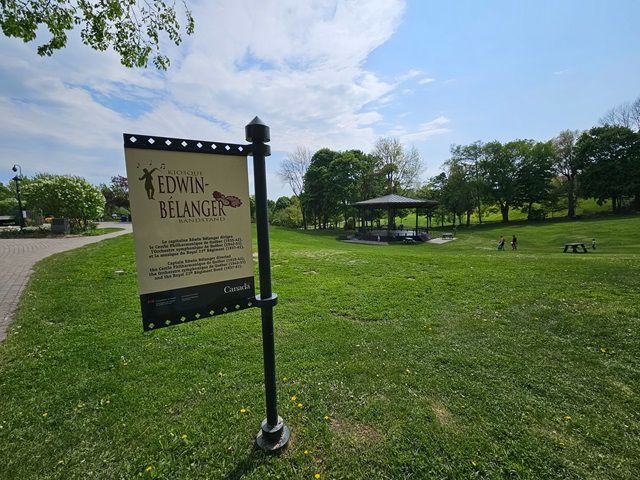
A concert venue in the summer, the Edwin Bélanger Bandstand was named after Edwin Bélanger, a noted Canadian conductor.
Joan of Arc Garden
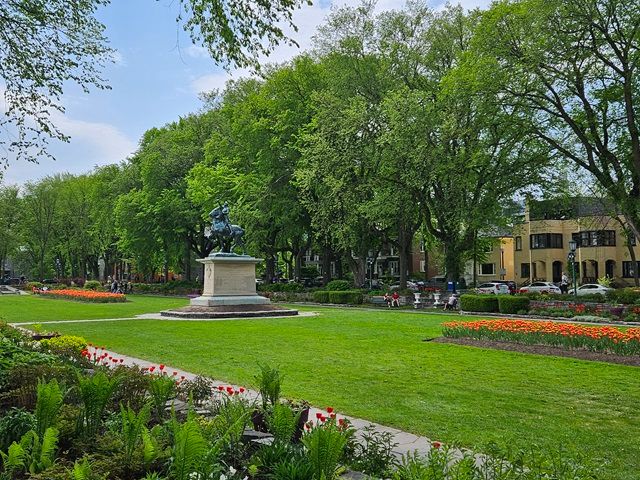
A peaceful garden area in one section of the park, the Joan of Arc Garden is lined with benches and lovely flowers, making it a popular place to sit and relax, chat, or read a book in the warmer months.
It is named after Joan of Arc, the French national heroine whose success in the Hundred Years’ War helped to kick the English out of her homeland – interesting choice, given the tensions between the French and English in Canada.
There’s a statue of Joan in the center of the garden. In true Canadian fashion, the inscription is in English on one side and in French of the other. The writing on the front is a compromise – it’s in Latin.
WWI Guns

I’ll admit, this wasn’t something I expected to see during my visit, but there are reminders of another conflict unrelated to the battle of 1759.
Several German field guns are lined up in one area of the park. They were brought to Canada as spoils of war and placed in the Plains of Abraham as a testament to the sacrifices made by Canadian soldiers during the First World War.
The Plains of Abraham Museum

If you want to learn more about the battle of the Plains of Abraham, there’s no better place to go than the Plains of Abraham Museum, on the edge of the park.
One my favorite exhibits here is the one on the lives of the soldiers – what they wore, their daily life, the weapons they used. It’s interactive, too. You can play the drums, literally unlock information, test how heavy a cannonball was, view models of the battle. If you’re looking for something to do with kids, you’ll want to add this place on your list.
An informative video relates the story of the battle through the people who experienced it. I appreciate that it gives voice to the everyday French, English, and First Nations participants of the battle, not just the big names you read about in the history books. The video plays twice an hour, once in English and once in French.
I’m honestly not sure why this museum isn’t more popular. We practically had it to ourselves when we were there.
Practical Information for the Plains of Abraham Museum

Location
835 Wilfrid-Laurier Ave, Québec City, Quebec G1R 2L3
Opening times
9:00am – 5:00pm daily
Ticket Prices
Ticket prices depend on the time of year (with summer being more expensive) (all prices in Canadian dollars):
Ages 25 – 65: $13.75 – $17.00
Ages 65+: $11.50 – $12.75
Ages 18 – 24: $6.88 – $13.75
Ages 13 – 17: $11.50
Ages 5 – 12: $4.75
Ages 4 and under: Free
Check the website for the most up-to-date information.
Recommended time to spend
1 – 2 hours
Near the Plains of Abraham

The Citadelle of Quebec is right next door to the Plains of Abraham. It’s both a historic fort and an active military barracks.
Access to the inside of the Citadelle is via guided tour only (it is, after all, an active military building).
During your visit the Citadelle, don’t forget to stop by the Royal 22e Régiment Museum to learn more about this predominately francophone Canadian regiment who call the Citadelle home.
Travel tip: You can get a discount if you visit both the Plains of Abraham Museum and the Citadelle.
Can’t enough of Canadian history? Head to the Old Town where you can check out even more historic places.
Inspired to visit the Plains of Abraham? Let me know in the comments!

Leave a Reply